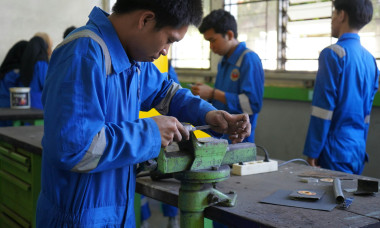
Every qualification tells a personal story but together they tell a nation’s
Every qualification tells a personal story. It might be someone’s first step into a career, a change in direction later in life or a second chance after leaving school before finishing year 12.
And for many, the impact is felt quickly. According to NCVER, 62.4% of VET completers improved their employment status after training, rising to 76.7% in industries such as electrotechnology.
None of that is just a positive outcome in a report. It's a person leaving education with opportunities they didn't have before.
VET also creates a different kind of opportunity. It doesn’t ask whether you had the perfect start. More than a quarter of students starting a qualification haven't finished school, demonstrating that the system is working as designed. VET is one of the only parts of Australian education that treats a late start, a gap year that became a gap decade, or a school experience that didn't quite fit, as irrelevant to whether you can retrain. That's a different kind of equity story to the one usually told about higher education access.
Now consider the scale. Across the country hundreds of thousands of qualifications are issued each year. Add those individual stories together and the national picture comes into focus.
One story. A national pattern.
Every one of those individual outcomes is part of something bigger across Australian workforces. Right now, nearly a third of occupations assessed by Jobs and Skills Australia are still in national shortage. While this figure is down slightly on last year, it remains significant. And in regional Australia, tens of thousands of vacancies sit in trades, technical and professional roles: exactly the kind of work VET exists to fill.
A lot of the conversation about skills shortages runs on policy, forecasting and labour-market data. Behind every one of those numbers is a person who finished a qualification and stepped into a job, changed careers, or picked up the skills to move forward. The shift in the national shortage rate from 33% to 29% did not happen in a spreadsheet. It happened one person, one qualification and one job at a time.
The qualifications being issued today are not only filling today's gaps. Deloitte and RMIT modelling suggests large businesses need to nearly double their share of green-skilled workers by 2030, which points to close to a million more green-skilled workers moving through the training pipeline. Today's students are the answer to shortages we can already see coming.
This is what National Skills Week symbolises best. Not just celebrating that VET can be life changing for the people who go through it, but recognising that those individual changes, added together, are how Australia builds the workforce it needs. One qualification doesn't just change one life. Multiplied, it's how a country keeps up with itself.
The system carrying that weight is under real pressure.
This is the part worth being honest about. Apprenticeship completion is the clearest example: fewer than a quarter of the most recent starting cohort has finished so far, and the average time to complete has stretched out considerably. Employer satisfaction with VET has also softened over the past decade.
Put those two facts together and there's a harder truth underneath. The system is being asked to produce more life-changing outcomes at exactly the moment it's taking longer to produce each one.
If the average apprentice now takes materially longer to finish than a cohort a few years ago, the opportunity VET creates is still real, but it's arriving later than it used to for the person living it - and later than industry needs it to.
That doesn't diminish the value of what VET delivers. If anything, it makes the challenge more urgent. The outcomes matter. The question is whether the system has the capacity to deliver them at the pace and scale Australia now needs.
The stories are real. Telling more of them, faster and more reliably, means the systems and support behind those journeys have to keep pace with what's being asked of them.
And in a way, those two things are connected. A system that creates opportunities at this scale will inevitably start to feel the pressure when demand outpaces the infrastructure supporting it. That pressure can show up in completion timelines, employer confidence and provider capacity.
Strain isn't evidence that the demand for VET was ever misplaced. It's a sign of just how much the system is being asked to carry.
What role does technology play?
This is where technology has an important role to play. Not by making education less human, but by taking some of the complexity away from the people responsible for delivering it.
Providers manage an enormous amount behind every student journey: compliance, AVETMISS reporting, audit readiness, funding requirements, employer sign-offs. All of it matters. All of it can pull time and attention away from the students those systems exist to serve.
Being part of the VET ecosystem means understanding that complexity. Vocational education isn't one of many sectors we work in. It's our foundation. We've spent decades working alongside providers to navigate the realities of the Australian training landscape. That experience shapes how we build technology: purpose-built for the sector, developed with the market and designed around the challenges providers are dealing with every day.
"Vocational education is under more pressure than ever, and it continues to deliver for the people and industries that rely on it. We don't see ourselves as separate from that effort - we work alongside providers every day, supporting the same compliance and reporting obligations they carry. Our focus is on giving that time back, so providers can spend more of it with students rather than paperwork." - Trevor Fairweather, Executive General Manager of Education, ReadyTech
Every qualification will keep telling its own story.
A first job. A new career. A second chance. Multiply that by everyone who walks through a TAFE or RTO this year, and you start to see the bigger picture. A more skilled, capable workforce built on one qualification at a time. That's what life changing looks like, at scale.